Strike Off a Company in Ireland – Voluntary Company Closure Guide
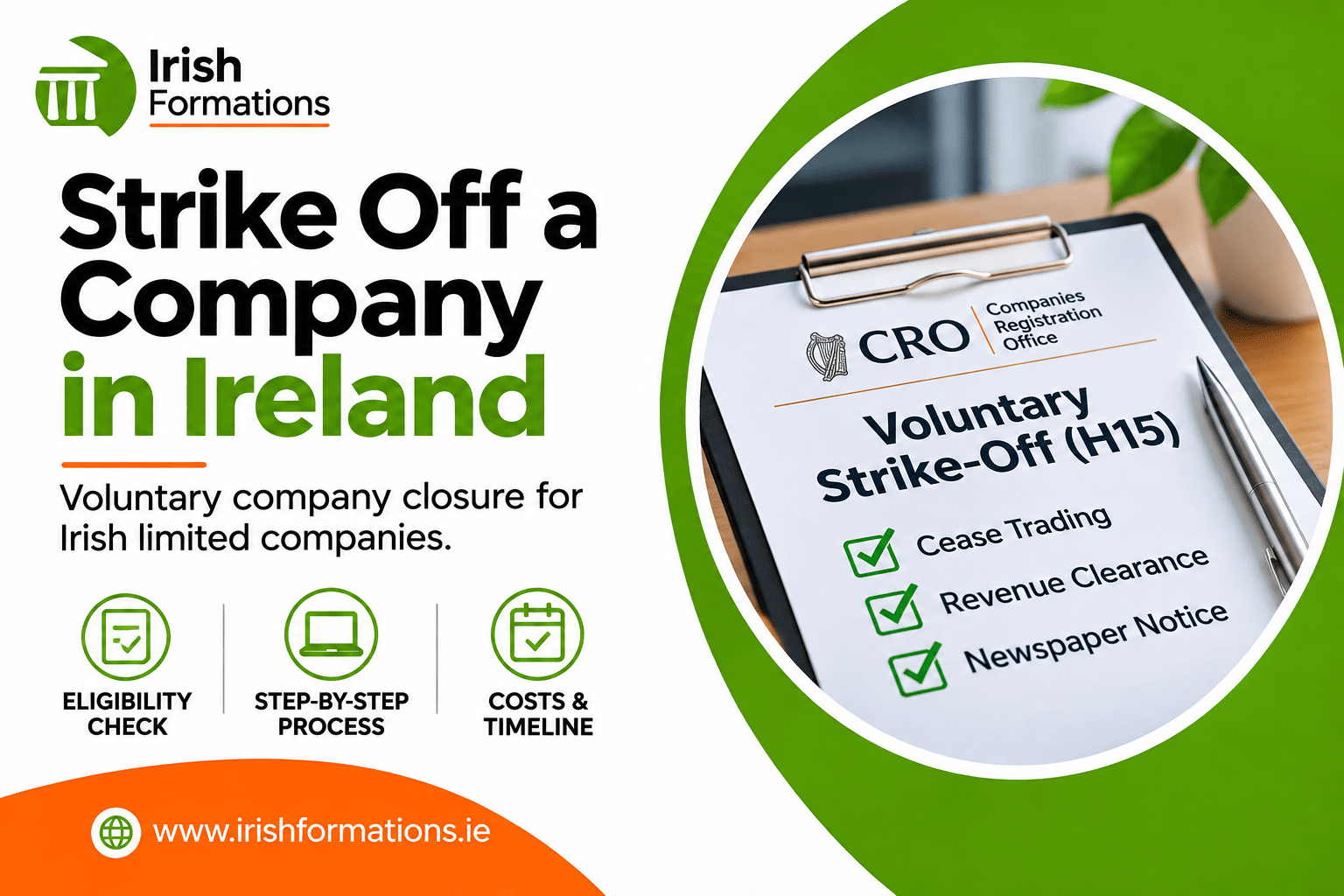
If you want to strike off a company in Ireland, the voluntary strike-off process may be the simplest way to close your Irish limited company. This procedure is suitable for companies that have stopped trading or have never traded, provided they meet the requirements of the Companies Registration Office (CRO).
Irish Formations provides a professional voluntary company strike-off service from €299 + VAT, including the required national newspaper advertisement.
Whether you are closing a dormant company, winding down an inactive business or no longer need your Irish limited company, we can help you understand the steps involved.
Order Our Voluntary Strike-Off Service – €299 + VAT
What Does It Mean to Strike Off a Company in Ireland?
To strike off a company in Ireland means to remove the company from the official register maintained by the Companies Registration Office.
Once the strike-off process is completed, the company is dissolved and ceases to exist as a registered legal entity, subject to the statutory provisions relating to restoration and continuing liabilities.
Voluntary strike-off is commonly used when a company has ceased trading or was incorporated but never commenced business.
Under Sections 731 to 733 of the Companies Act 2014, eligible companies can apply to the CRO for voluntary removal from the register.
This process is different from liquidation, which may be necessary where a company has substantial assets, outstanding debts or more complicated financial affairs.
You can read the official requirements on the CRO voluntary strike-off guidance page.
Who Can Apply for Voluntary Strike-Off in Ireland?
Before you can strike off a company in Ireland, the company must satisfy several statutory requirements.
The main conditions include:
- The company has never traded or has ceased trading.
- The company’s assets do not exceed €150.
- The company’s liabilities, including contingent and prospective liabilities, do not exceed €150.
- The company is not involved in ongoing or pending litigation.
- All outstanding CRO annual returns have been filed.
- The company has passed the required resolution within three months before its application.
- Revenue has issued a valid letter confirming that it has no objection to the strike-off.
- The company has published the required advertisement in an approved national daily newspaper.
It is important to understand that assets and liabilities are assessed separately. A company cannot simply offset its debts against its assets to satisfy the €150 limits.
If your company has outstanding liabilities or assets above these thresholds, you should resolve those matters or obtain professional advice before proceeding.
How to Strike Off a Company in Ireland: Step-by-Step
The voluntary company closure process involves several stages. Irish Formations can assist with preparing the documentation and coordinating the application.
Step 1: Check the Company’s CRO Filing Position
The first step is to establish whether the company is eligible for voluntary strike-off.
All outstanding annual returns must be filed with the CRO. Any applicable filing fees and late penalties must also be addressed.
A company that has never traded is not automatically exempt from filing annual returns.
If your company has outstanding filings, you can learn more about Irish company annual return requirements.
Step 2: Confirm the Company Has Ceased Trading
The company must have ceased carrying on business or never have commenced trading.
Before applying, directors should review the company’s financial position and deal with outstanding creditors, bank balances, company property and any remaining obligations.
The directors must also ensure that the company satisfies the statutory asset and liability limits.
Step 3: Pass the Required Company Resolution
The company must pass a special resolution confirming its intention to apply for voluntary strike-off.
The resolution must also confirm that the company will not carry on business or incur further liabilities while the application is being considered, unless the process is cancelled.
The resolution must be dated within three months before the strike-off application is received by the CRO.
The resolution details are included in the online Form H15. A separate Form G1-H15 is no longer required.
Step 4: Obtain Revenue’s Letter of No Objection
Before the CRO can complete the voluntary strike-off application, the company must obtain written confirmation from the Revenue Commissioners that Revenue has no objection to the company being removed from the register.
The company may need to deal with outstanding tax returns, liabilities or tax registrations before Revenue will issue its confirmation.
The letter must be dated no more than three months before the CRO receives the application.
Company cessation for Revenue purposes and voluntary strike-off at the CRO are related but separate procedures.
Further information is available from the Revenue Commissioners.
Step 5: Publish the National Newspaper Advertisement
A voluntary strike-off application requires a newspaper advertisement announcing the company’s intention to be removed from the register.
The advertisement must appear in an approved daily newspaper circulating nationally in Ireland, within 30 days before the application is delivered to the CRO.
The advertisement must contain the prescribed information about the company.
Additional details may be required where the company changed its name or registered office within the preceding year.
Irish Formations includes the national newspaper advertisement in its advertised €299 + VAT strike-off service.
Step 6: Submit Form H15 to the CRO
The formal application is submitted using Form H15 through the CRO’s online filing system, CORE.
The H15 application includes the required directors’ certifications and supporting documentation, including Revenue’s letter and evidence of the newspaper advertisement.
The CRO filing fee for Form H15 is €15.
Once the application has been submitted, the CRO examines the documentation and, if satisfied, proceeds with the statutory strike-off process.
Step 7: Wait for the Company to Be Dissolved
After the CRO accepts the application, the proposed strike-off is advertised through the CRO Gazette process.
There is a statutory objection period during which an eligible party may object to the company’s removal from the register.
If the necessary requirements are satisfied and no successful objection prevents the strike-off, the Registrar may proceed to dissolve the company.
Directors should monitor the company’s CRO status until dissolution is confirmed.
How Much Does It Cost to Strike Off a Company in Ireland?
The cost of closing an Irish limited company depends on whether the company is eligible for voluntary strike-off and whether its statutory filings and tax affairs are up to date.
Irish Formations offers a voluntary strike-off service for €299 excluding VAT (€367.77 including VAT).
Our advertised service includes preparation and coordination of the strike-off documentation and the required national newspaper advertisement.
The CRO charges a separate statutory filing fee of €15 for Form H15. Confirm the treatment of this fee and any additional work required before placing your order.
Where annual returns are outstanding, or additional accounting or tax work is necessary, further costs may arise.
View Our Voluntary Strike-Off Service and Order Online
How Long Does It Take to Strike Off an Irish Company?
Voluntary strike-off is not an immediate process.
The overall timeline depends on the company’s filing position, the time required to obtain Revenue clearance, the preparation of the advertisement and the CRO’s processing times.
After the required documents are accepted, the CRO must also complete the statutory publication and objection stages.
The objection period is generally 90 days following the relevant Gazette notice.
For planning purposes, directors should allow several months for the entire company closure process. Additional time may be required where tax matters, annual returns or other compliance issues remain outstanding.
Irish Formations can assist with preparing the application and monitoring its progress.
Can You Strike Off a Company That Has Never Traded?
Yes. A company that has never traded may be eligible for voluntary strike-off in Ireland.
This is a common situation where a limited company was incorporated for a proposed business venture that never proceeded.
However, the company must still satisfy the statutory requirements.
For example, the company must have filed its outstanding annual returns, have no disqualifying liabilities or assets and obtain the necessary Revenue clearance.
Directors should not assume that a company has no obligations simply because it never issued invoices or opened a business bank account.
Can You Close a Company With Outstanding Debts?
A company with outstanding liabilities exceeding €150 cannot use the standard voluntary strike-off procedure until it meets the relevant statutory requirements.
The CRO also makes clear that company assets and liabilities cannot simply be offset against each other to meet the limits.
If a company owes money to suppliers, Revenue, employees or other creditors, those liabilities must be carefully assessed.
Where the company is insolvent or cannot settle its debts, liquidation or another appropriate legal procedure may be necessary.
Directors should obtain professional advice before attempting to close an insolvent company.
What Happens if You Simply Stop Trading?
Stopping business activity does not automatically close an Irish limited company.
Until a company has been properly dissolved, its directors generally remain responsible for the company’s statutory obligations.
These may include filing annual returns, maintaining a registered office, dealing with tax matters and ensuring that the company’s records remain compliant.
Failure to meet these obligations can result in late filing penalties, enforcement action and potential involuntary strike-off.
You can read more in our guide to how a company can be struck off the register.
For directors who no longer need their company, a properly managed voluntary strike-off is generally preferable to allowing compliance problems to accumulate.
What Is the Difference Between Company Strike-Off and Liquidation?
Both procedures can result in an Irish company being dissolved, but they are designed for different circumstances.
Voluntary strike-off is generally appropriate for an inactive company that has ceased trading or never traded and satisfies the statutory asset, liability and filing requirements.
Liquidation is a formal winding-up process involving a liquidator. It may be required where the company has significant assets, debts or financial matters that must be resolved before dissolution.
A company that cannot meet the conditions for voluntary strike-off should seek appropriate legal or insolvency advice.
Do You Need a Registered Office During the Strike-Off Process?
Yes. A company must maintain a valid registered office while it remains on the CRO register, including during the voluntary strike-off process.
If you currently use a registered office service, you should maintain the necessary arrangements until the company’s dissolution is confirmed.
Irish Formations provides a registered office address service in Ireland for companies requiring an Irish registered office.
Registered office fees are separate from the voluntary strike-off service and may continue to apply while the company remains registered.
Frequently Asked Questions About Company Strike-Off in Ireland
Can I strike off my own company in Ireland?
Yes. Directors can arrange a voluntary strike-off application themselves, provided the company meets the legal requirements and the necessary documentation is submitted correctly.
Alternatively, Irish Formations can assist with preparing and coordinating the process.
Is voluntary strike-off the same as company cessation?
Not exactly. Company cessation commonly refers to stopping business activity or ending tax registrations. Voluntary strike-off is the formal CRO procedure that can lead to a company being dissolved.
Do I need Revenue approval to close my company?
A voluntary strike-off application requires a letter from Revenue confirming that it has no objection. The letter must satisfy the CRO’s timing requirements.
Can I strike off a company with overdue annual returns?
All outstanding annual returns must be filed before the voluntary strike-off application can proceed. Late filing penalties and other applicable charges may also need to be resolved.
Can a company be restored after strike-off?
In certain circumstances, a dissolved company may be restored to the register through the applicable statutory procedure. Restoration requirements and time limits depend on the circumstances.
Can a creditor object to a voluntary strike-off?
Yes. Creditors and other eligible parties may object where the statutory grounds for objection apply.
How much does Irish Formations charge to close a company?
Our voluntary strike-off service is advertised at €299 plus VAT, including national newspaper advertising. Additional costs may apply where statutory filings, CRO fees or other matters require attention.
Why Choose Irish Formations for Company Closure?
Irish Formations has provided Irish company formation and corporate services since 2009.
We understand that directors may need to close a company for many reasons. A business may have ceased trading, a proposed venture may never have started, or the owners may simply no longer require the limited company.
Our voluntary strike-off service is designed to help eligible directors manage the necessary paperwork and follow the CRO process.
We can assist with reviewing the company’s position, preparing supporting documentation, coordinating Revenue clearance, arranging the newspaper advertisement and progressing the CRO application.
Our advertised service price is €299 + VAT, including the required newspaper advertisement.
Start Your Voluntary Company Strike-Off Today
If you are ready to strike off a company in Ireland, Irish Formations can help you take the next step.
Before ordering, ensure that your company has ceased trading or never traded, that its annual returns are up to date and that its financial position meets the statutory requirements.
Order Your Voluntary Strike-Off Service – €299 + VAT
You can also contact Irish Formations if you would like to discuss your company’s circumstances before proceeding.
This guide provides general information about voluntary company strike-off in Ireland. It does not replace legal, tax or insolvency advice where a company’s circumstances require specialist assessment.